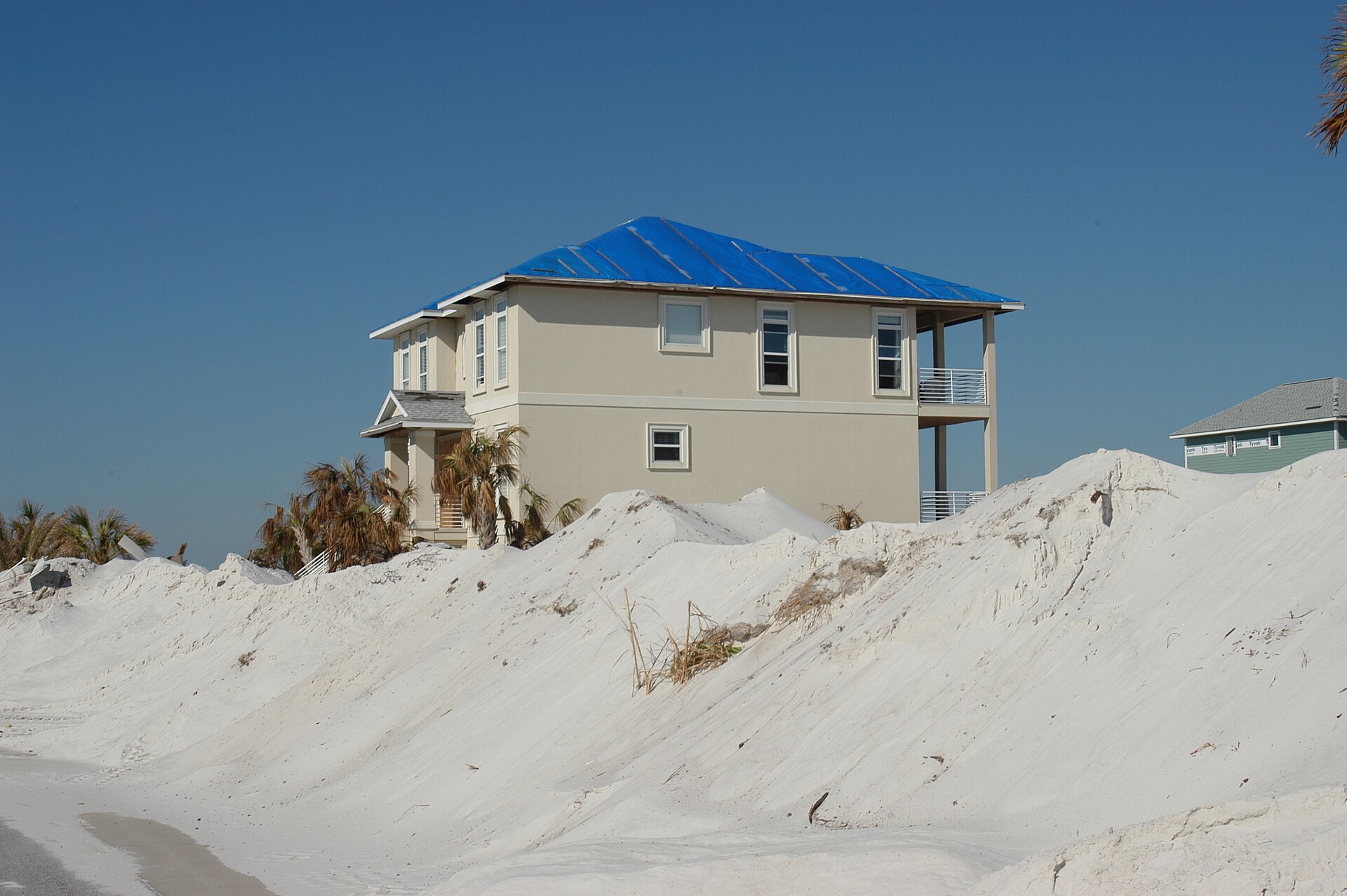
I don’t see any leaks or damage after the storm. Does that mean I’m in the clear?
Not necessarily. This is the question we get asked most, for a reason. Wind and impact routinely break a roof’s water resistance without opening a hole. Lifted shingles, cracked tile, damaged flashing and lost granules can sit for weeks or months before the first leak shows up, usually during an ordinary rainstorm long after the storm that caused it.
A roof is a layered system, not a single surface. The covering sheds most of the water; the underlayment beneath it is the actual barrier. Wind lifts a shingle, breaks its seal, and lets it drop back down looking exactly as it did before, except now it is a flap rather than a bond, and the layer underneath is taking weather it was never meant to take alone.
The lag is also structural. Water that gets past the covering travels sideways along the deck before it finds a path down, and insulation absorbs a good deal before anything appears on a ceiling. By the time you see a stain indoors, the problem is usually months old and has been quietly wetting sheathing the whole time.
This is why “it looks fine from the street” and “it isn’t leaking” are both weak evidence, and why the useful thing to do after a significant storm is to look properly once, rather than wait for proof.
What should I check myself after a storm?
Start in the attic within a day or two. Go up during the day with the lights off and give your eyes a minute. Any daylight showing through the deck is a gap in the roof above it.
Then use a flashlight on the deck, the framing and the insulation, especially where the roof meets the walls, and look for staining or anything damp. It is the highest-value two minutes available to you and almost nobody does it.
Then check what you can reach. Hail and debris do not single out the roof, so your roof took the same weather from a far worse angle. If the things you can see from the ground took a beating, you can assume your roof did too.
At eye level, look for:
- Dents on the car, the mailbox, the grill or the AC condenser fins
- Dents in the gutters, the downspouts and any metal vent caps
- Granules collecting at the base of the downspouts
- Covering that has slipped or gone missing, and soffit that is sagging
Binoculars help with anything too far up to see clearly. Photograph what you find.
Don’t climb up. Roofers do this with fall protection and enough experience to tell which parts of a damaged roof will hold weight. Call one instead, and tell them what you saw from the attic and the ground. After a storm there are more calls than there are hours to walk roofs, and specifics move you up the list.
Should I call my insurance company or a roofer first?
Call your insurer first. It is your policy, the notice requirements sit inside it, and a roofing contractor cannot advise you on your coverage. What a contractor can separately tell you is what they see on the roof and what they estimate a repair would cost.
You will find plenty of roofing companies advising the opposite, and it is worth understanding why. A contractor who reaches you before your insurer does gets to shape the whole conversation. Sometimes that is genuinely helpful. Often it is not, and the companies that push hardest on it are likely not the ones who have your best interest in mind.
To be plain about our own limits: Corvex is not a public adjuster and does not handle insurance claims. We cannot tell you what to file, what your policy covers, or what your insurer owes you. Nobody holding only a roofing license is qualified to do that, and in Florida there are specific rules about contractors who try.
What we can help with is showing you what the roof actually needs before you make any decisions. Once you know what your policy covers, knowing what the work costs is what turns it into a decision instead of a guess. Call us whenever you want it looked at.
Part of my roof covering is missing. Do I have to tarp it?
Missing covering means bare patches where shingles have blown off or tiles have slipped out of line, with the underlayment showing underneath. If that’s what you’re looking at, then yes, and it’s worth doing promptly. Florida homeowners policies commonly include a duties-after-loss provision requiring you to take reasonable steps to protect the property from further damage. Covering an exposed section is that step.
Missing covering matters more than it looks like it does. Wind gets under the edge of what’s left and keeps lifting, so a small missing section usually becomes a bigger one in the next weather. And the layer that’s now exposed is a temporary barrier sitting in direct sun, which is not what it was made for. An exposed section that isn’t leaking still needs covering.
If there’s time before the next rain, call your insurance company first and ask about coverage for emergency tarping. The Florida Department of Financial Services runs a consumer services division if you cannot get a straight answer. If there isn’t, get someone out to cover it and sort the paperwork after. Photograph the damage before the tarp goes on and keep receipts for the tarp, the labor and any water extraction. Ask your insurance company how they want those costs handled, and don’t let waiting on an answer stop you from covering the roof.
Get someone licensed and insured to put it on. Tarping is roof work, in bad conditions, on a surface that just got damaged.
My roof took some damage, but money’s tight. Is there a real cost to waiting?
Yes. Finding out what you’re dealing with costs nothing. The damage keeps spreading while you wait, and the more there is, the more it costs to fix.
Most of that comes down to what water does once it’s in the structure. It runs along the deck and soaks into whatever it reaches, so the wet area keeps spreading out from the damage. Plywood that stays damp softens, loses its grip on fasteners and eventually rots, and in a Florida attic that process doesn’t need a leak in the ceiling to keep going. It just needs time.
That’s also why the cost climbs. Replacing a section of covering is a straightforward repair, but if the underlayment beneath it has been soaked, that comes off too, and once the sheathing has gone soft you’re into the deck and paying for structure instead of roofing.
What we can tell you is what we see on the roof and what we estimate it would cost, and how old it is if you do not already know. That part is free, and if the roof is sound we’ll say so.
How do I know whether to trust a roofer who tells me I have a problem?
Check the license before you sign anything or let anyone on your roof. Roofing work in Florida requires a state roofing license, you can look it up at myfloridalicense.com, and a legitimate one won’t mind you doing it while they wait.
It matters because of what you’re left with. A full replacement generally requires a permit and an inspection, and you can search any Florida contractor license before you sign, and an unpermitted roof tends to surface later, usually at closing and usually as your problem. Improper installation also voids the coverage on the materials, and the better manufacturer warranties require an installer that manufacturer has certified.
The three highest-signal red flags
- Someone claiming they noticed damage from the street, or from a drone. Nobody diagnoses a roof from the street.
- Pressure to sign before they leave, or pricing that expires today. Real quotes survive the weekend.
- A large cash deposit, no local address, and no Florida license number on the paperwork.
Any contractor who tells you the offer disappears if you take a day to think about it is telling you something useful about themselves.
My roof age keeps getting asked for. Where do I actually find it?
It’s usually easier than people expect, and it’s worth knowing, since a twelve-year-old roof and a twenty-two-year-old roof with the same damage aren’t the same conversation.
The list of places is longer than most people expect. Roof age is on the application when you shop for insurance and on the paperwork at renewal, it is the first line of a wind mitigation inspection form, and it comes up again in the disclosures when you sell.
Most people go looking for the date only once somebody requires it, which is reliably the least convenient moment to start calling the county.
Check your closing documents first. If the roof was replaced before you bought the house, the date is often in the disclosures or the inspection report.
If it is not there, try your local building department. A full roof replacement generally requires a permit in Florida, so a past reroof tends to be on record with whoever issued it. Call and ask how they handle records requests and how far theirs go back.
Smaller repair work often does not require a permit, so not everything shows up. If the paper trail runs out, a roofer can give you a range from the condition of the covering.